The One-on-One Advantage System
A leadership operating system, built from five recurring One-on-Ones.
Most leadership advice asks you to be a different person. The One-on-One Advantage doesn't. It asks you to install a rhythm of five One-on-Ones, repeated week after week, that move every person on your team from dependency to ownership, and free you to do the strategic work you were hired for.
The system at a glance
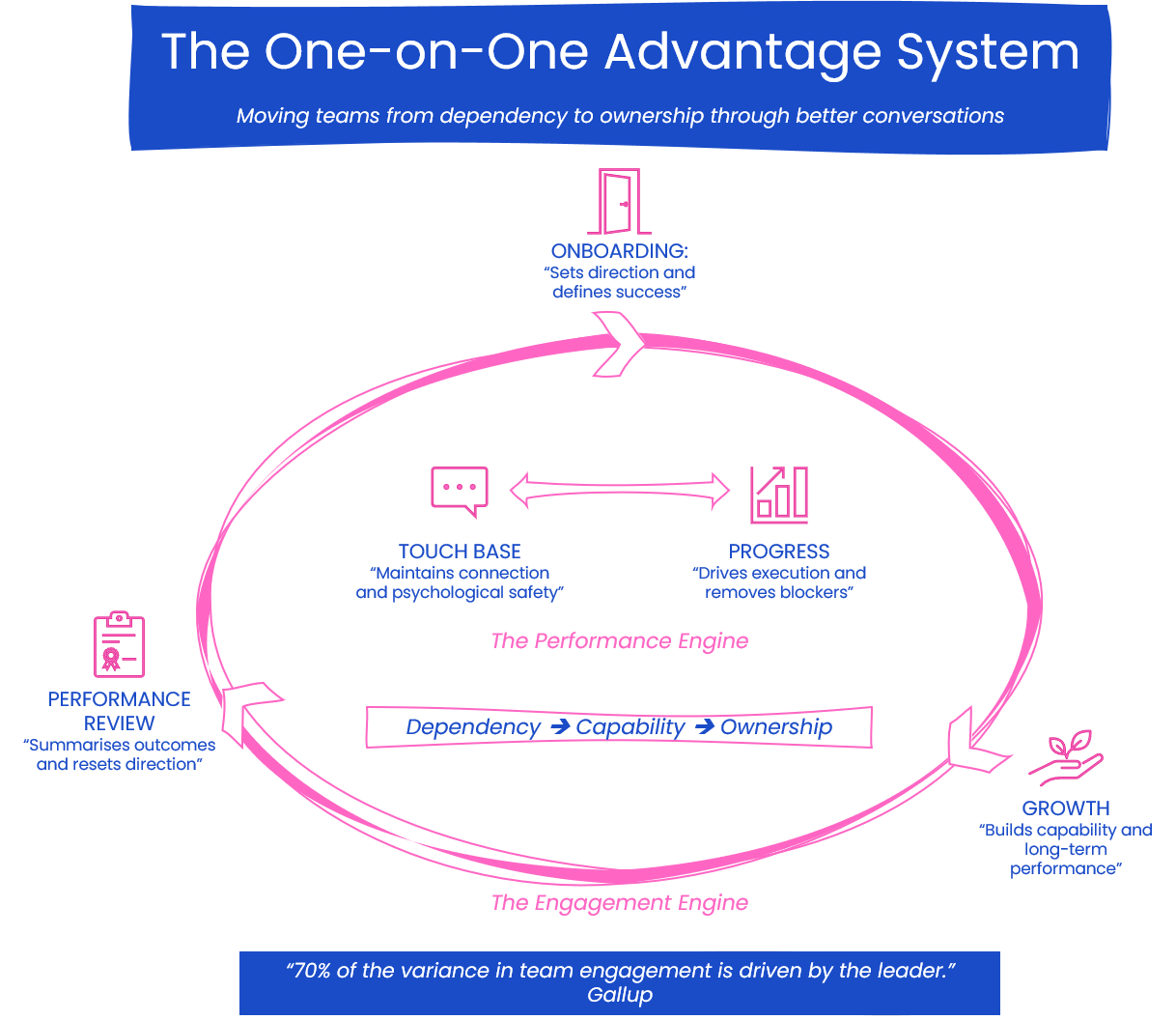
Five conversations. Two engines — performance and engagement. One progression: dependency to capability to ownership.
Why this matters
70%
of the variance in team engagement
explained by the manager
Source — Gallup
The manager is the variable. Everything else is downstream of that.
Not the strategy. Not the market. Not the perks. The single biggest factor determining how people show up, how much they care, and how willing they are to take ownership is the person leading them.
That isn't a burden, it's the leverage. And the most concentrated form of that leverage sits in the conversations a leader has with each person on their team, week after week. The One-on-One Advantage is the system that makes those conversations consistent enough to compound.
How it Works
Two engines, working in parallel.
One progression that compounds.
The Five One-on-Ones cluster into two engines. The first protects the work happening this week. The second builds the capability that will be doing the work in twelve months. They don't replace each other, they amplify each other.
-
Engine One
The Performance Engine
The conversations that protect what's being delivered right now, how the work flows, what's blocking it, where the standard is slipping, where it's being met. Short cadence, real-time, oriented to the present.
This is what most leaders already attempt. The system makes it consistent enough to compound.
The One-on-Ones inside it
Touch Base — brief, beside the work, daily.
Progress — structured, fortnightly, led by them.
-
Engine Two
The Engagement Engine
The conversations that build the person doing the work, their capability, ownership, sense of trajectory. Longer cadence, oriented to the year and beyond, the work that creates retention and replaces the need for crisis intervention.
This is what most leaders defer. The system makes deferring it harder than holding it.
The One-on-Ones inside it
Onboarding — transition led, not induction processed.
Growth — the balcony view, every four to six weeks.
Performance Review — a summary of a year already understood.
The Progression
Every conversation moves a person along one line.
Want each conversation unpacked — with the seven-question diagnostic and the shift model?
The 17-page e-book takes each of the Five One-on-Ones in turn, purpose, cadence, structure, the shift it produces, and ends with a short diagnostic to surface where the system is most needed in your team right now.
Twelve months in
What changes when the system actually runs.
The shift doesn't happen in a quarter. Early signals arrive within weeks; the cumulative impact is visible at twelve months. The gap between the two columns isn't effort, it's discipline.
-
Without the system
Conversations happen when there's time — which means inconsistently.
Feedback is saved for the review, and arrives too late to act on.
Development is reactive, sporadic or absent.
The performance review is an event that generates anxiety.
The leader carries the engine.
Engagement varies by leader, team and month
-
With the system
Conversations are protected, predictable, and held to a standard.
Feedback is continuous, and flows in both directions.
Development is intentional, co-owned, and connected to real work.
The performance review is a summary of a year already understood.
The team becomes the engine.
Engagement becomes a structural outcome, not a personal dependency.
Take it further
Two ways to start.
One more on the way.
The fastest entry point is the free e-book. Beyond that, the One-on-One Advantage runs as a one-day workshop for leadership teams, and the full book is in production.
-
Start here · free
The e-book
A 17-page introduction to the five-One-on-One system. Seven-question diagnostic, the Leadership Shift Model, and the side-by-side of what changes in twelve months. Designed to be read in a sitting and used the same week.
For: any leader who wants to start the same week.
-
Apply it · full-day workshop
The workshop
A facilitated full-day with a leadership cohort , 12 to 24 leaders. Run a Progress One-on-One under observation. Place every direct report against the Shift Model. Leave with a 90-day implementation plan and an accountability partner from the cohort.
For: leadership teams installing the rhythm together. Pre-read the e-book; arrive ready to practise.
-
In production
The full book
The complete methodology, seven chapters covering all five One-on-Ones in full, the seven onboarding conversations, the five capabilities that build leaders along the ownership progression, and the difficult situations every leader eventually meets.
Coming Soon
For: leaders who want the full system, end to end.
Built By
Twenty-five years running operations before coaching the leaders who run them now.
Matt is a leadership and team coach based in Perth, working with senior leaders across Australia and internationally. He spent twenty-five years in operations leadership and transformation across Pfizer, Nestlé, Lion, Cadbury, Procter & Gamble, Synergy and Water Corporation before moving into coaching full time.
The One-on-One Advantage is the system he tested, refined and rebuilt across decades of practice. It works because it isn't theory, it's what leadership actually requires when a leader decides to lead differently.
Based on Whadjuk Country, Perth, Western Australia.
Credentials & Focus
ICF Associate Certified Coach (ACC)
25 years leading operations and enterprise change
Operational Excellence, Lean Six Sigma — deep practitioner
Certified Agile enterprise coach
Works primarily with mining, pharma, FMCG, food & beverage, utilities